Journalist Attacked as Election Violence Mounts in Nigeria Ahead of 2027 Vote
An assault on a reporter covering an opposition event in Lagos highlights a surge in political violence, with more than 100 peace accord breaches recorded as campaigning intensifies before the January 2027 general election.
By Madison Darwish ·
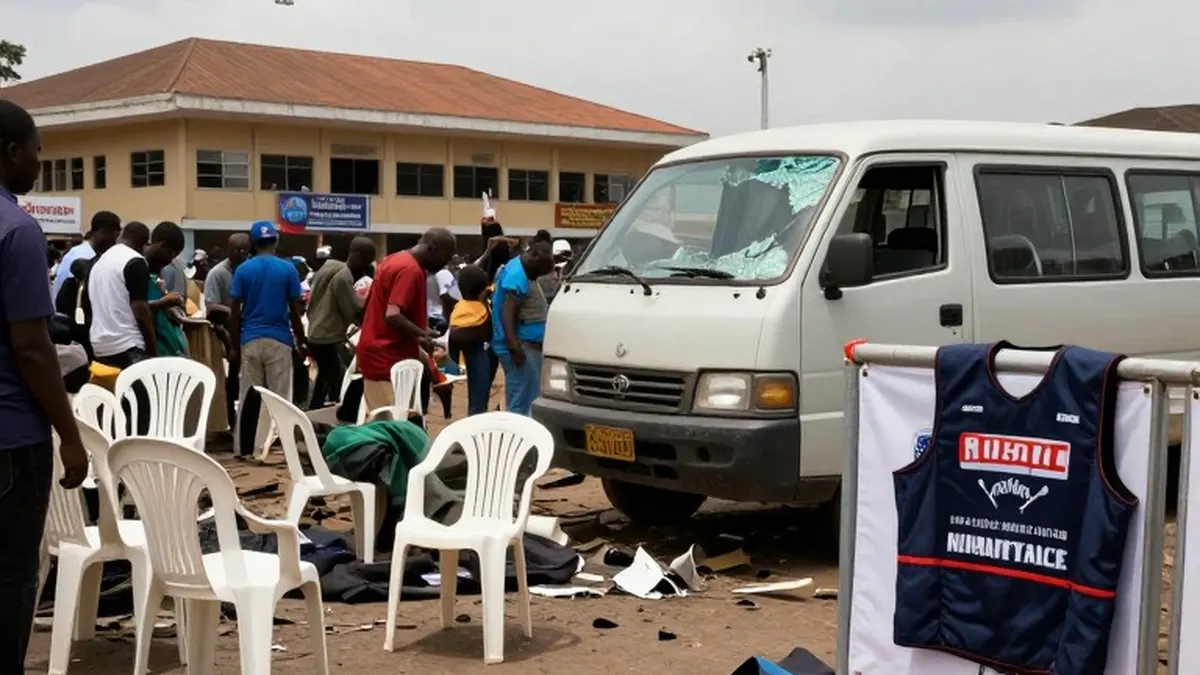
A routine reporting assignment in Lagos turned into a violent ordeal for Nigerian journalist Samuel Adebanjo, who was attacked by armed men while covering a town hall meeting organized by the opposition National Democratic Congress in the Oregun area of the city.
Adebanjo said he was photographing people entering the venue when buses pulled up and he heard a loud bang. Men armed with axes, cutlasses and wooden planks began chasing party supporters, sending many fleeing for safety. He ran toward the parking lot, but a group of five attackers caught up with him. Despite his press jacket, they accused him of being the party's cameraman and tried to seize his camera.
"They wanted to collect the camera. I was struggling with them because I didn't want them to take it away. In the process, my middle finger was broken," he said. During the struggle, one attacker swung an axe at his wrist. He raised his hand to block the blow, and the blade landed on his wristwatch, a moment he said made clear the assailants were serious and forced him to surrender his equipment. He was later treated in hospital for a broken middle finger and internal injuries around his ribs. Several other people were hurt, and vehicles belonging to party supporters were destroyed.
The assault is part of a wider pattern as Nigeria moves toward its general election on January 16, 2027, in which President Bola Tinubu is seeking re-election on a platform centered on fighting insecurity and tackling the country's economic crisis. According to the National Peace Committee, 109 breaches of the National Peace Accord have been recorded across 26 states and the federal capital, Abuja.
Between August 19, when campaigning officially began, and October 27, political violence and thuggery accounted for 33 violations, while misinformation and disinformation made up 29. Analysts warn that the unrest surrounding rallies and town halls could damage the credibility of the vote and deter participation.
On November 15, the campaign convoy of former Kano state governor and NDC vice-presidential candidate Rabiu Kwankwaso came under attack during a visit to the Bichi area of Kano. Similar incidents were reported in Sokoto and Kebbi when former Vice President Atiku Abubakar campaigned in the northwest. Civil society groups, including Amnesty International, have condemned the violence and called on security agencies to hold perpetrators accountable. President Tinubu has also denounced the attacks, warning that intimidation and political thuggery that threaten public order will not be tolerated.
Electoral violence has a long history in Nigeria. The post-election unrest that followed the 2011 vote killed at least 800 people during days of rioting across northern states. Raheem Mutiu, a Nigerian researcher at the Armed Conflict Location and Event Data project, told DW that political groups now appear "more agitated and determined to win elections by all means." He said more than 30 politically linked attacks with 10 fatalities have been recorded in about two months, describing the violence as more frequent and geographically widespread than before. He noted that Nigeria's winner-takes-all politics fuels fierce competition, while perpetrators are hard to identify because they often act anonymously as proxies.
Dengiyefa Angalapu, a researcher at the Abuja-based Center for Democracy and Development, said a voter choosing under threat is not choosing freely. He warned that fake news and hate speech "can deceive voters and undermine trust in genuine information," and that intimidation could push people to avoid meetings or leave politics entirely.
More than 103 million Nigerians are registered to vote in 2027, according to the electoral authority, but turnout has been persistently weak. Only 27 percent of nearly 94 million registered voters cast ballots in 2023, the lowest figure since the return to democratic rule in 1999. Adebanjo, still recovering, now questions what the violence means for ordinary citizens: "If this could happen to me, a journalist, how much more to the citizens? I am not sure, at this stage, people will even come out to vote."