Brazil's Lula secures narrow win in chaotic runoff, maintaining independent stance from Washington
The 81-year-old leader defeats Flávio Bolsonaro by 4.4 million votes, keeping Latin America's largest economy aligned with left-of-centre leadership despite U.S. tariff pressures.
By Emmanuel Faure ·
Brazilian voters have chosen Luiz Inácio Lula da Silva for a fourth non-consecutive term as president, a result that preserves the independence of Latin America's largest economy from Washington. With 100 per cent of the vote counted, Brazil's electoral court confirmed that Lula, who turns 81 on Tuesday, defeated opponent Flávio Bolsonaro by nearly 4.4 million votes. Lula captured 51.8 per cent of the total vote in the Sunday runoff.
The election timeline was marked by a sudden procedural change that delayed final tallies. On Sunday, three minutes before the scheduled end of voting, Brazilian Supreme Court Justice Cristiano Zanin ruled to keep polling stations open for two additional hours. Both campaigns had requested the extension. Lula's team cited transportation issues for voters in São Paulo and Salvador, while Bolsonaro's team pointed to heavy rains in the southern states where he holds support. The decision delayed the announcement of results and created confusion at ballot boxes across the country.
Zanin, who made the ruling, previously served as Lula's lawyer. Bolsonaro ally Nikolas Ferreira noted this connection after the decision. At one polling station in Rio de Janeiro, voting machines had been switched off minutes after the original closing time and could not be restarted. In Brasilia, volunteers debated whether to stay after the extension, with most leaving 15 to 20 minutes after polls closed. It remained unclear how many stations remained open beyond the initial deadline.
Lula addressed supporters after the electoral court confirmed his victory. He expressed gratitude to the Brazilian people and pledged to respect all citizens regardless of gender or religion. He also directed criticism at his opponent, stating, "This was a defeat for denialism and lies. I must confess that every time I attended a debate, I felt embarrassed." Lula reinforced his commitment to national sovereignty, declaring, "Either the homeland remains free or we die for Brazil. This country will not accept being anyone's backyard."
Flávio Bolsonaro said after the results were announced that he wants the election "anulled" due to the two-hour extension. He had not yet formally conceded or provided a detailed response to the apparent defeat. The outcome bucks a recent regional trend where right-of-centre candidates allied with U.S. President Donald Trump have won office. The victory leaves Mexico and Brazil, the two most populous nations in Latin America, under left-of-centre leadership.
Lula’s win occurs against a backdrop of increased tariffs imposed by the United States. Brazil's gross domestic product stands at 2.6 trillion U.S. dollars per year. The result positions the country to remain independent of U.S. influence despite these economic pressures. In the first round earlier this month, Bolsonaro led Lula by more than 2.2 million votes. Sunday’s outcome marks the first time since the end of Brazil's military dictatorship in 1985 that the second-highest vote-getter from the first round won the presidency.
Campaign issues centered on the cost of living and public security. Bolsonaro campaigned on a tough-on-crime platform and pledged to reduce food costs. Lula, seeking undecided voters, invested in costly government incentives. Both candidates faced corruption suspicions involving family members and allies. Bolsonaro is implicated in a sprawling scandal, while Lula previously spent more than a year in prison on convictions that were later annulled.
Lula began his political career in the 1970s as a union leader and helped found the Workers' Party. He won the presidency in 2002, was re-elected in 2006, and served until 2010. His successor, Dilma Rousseff, was impeached in 2016. Lula was convicted of corruption in 2017 and jailed in 2018, serving 580 days before his release. The Supreme Court annulled his sentence after finding the presiding judge was biased. He narrowly defeated former president Jair Bolsonaro in 2022.
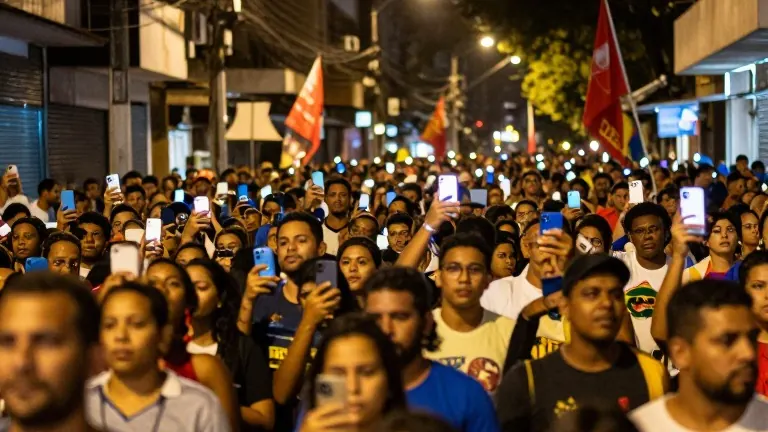
Celebrations erupted in major cities following the confirmation of the result. In São Paulo, hundreds of supporters gathered on the city's main artery. In Rio de Janeiro, car horns blared and crowds cheered as the vote count reached 100 per cent. Lula, wearing star-shaped red glasses, was seen celebrating with his wife, Rosângela Lula da Silva, and allies. He now joins U.S. President Donald Trump and Nicaraguan President Daniel Ortega as the oldest sitting presidents in the Americas, all aged 80.
Lula’s next term begins on Jan. 5, 2027. He will enter office as the leader of a country that defied the regional shift toward right-wing governance aligned with the United States. The election result ensures that Brazil's political direction remains distinct from Washington's, maintaining a complex dynamic in the hemisphere's most populous and economically powerful nations.
Source: CBC News