Conegliano Valdobbiadene Producers Defy Heat Record in 2026 Harvest
Yields in Italy's premium sparkling wine region remain stable despite record temperatures, though rising costs and changing vine practices challenge long-term viability.
By Madison Darwish ·
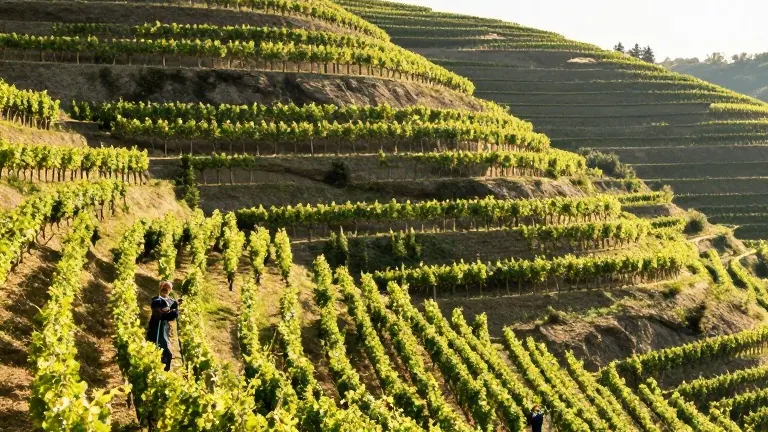
Producers in the Conegliano Valdobbiadene region of northeastern Italy expect this year's Prosecco harvest to match last year's volumes, even after one of the hottest growing seasons on record. The region, known for steep, high-altitude vineyards north of Venice, weathered a summer marked by drought and temperatures several degrees above historical averages. The consortium representing this exclusive denomination reported that quantities are broadly in line with 2025 levels.
The 2026 growing cycle began about 10 days earlier than the historical average. By September 15, 90% of the harvest was complete. Consortium director Diego Tomasi stated that this summer's conditions closely resembled climate models that predicted such extremes would arrive around 2045. The growing cycle for these vines has shortened by as much as 16 days over the last two decades.
The heat was not limited to daytime highs. The region recorded 60 nights where temperatures stayed above 20 degrees Celsius. Four of those nights were classified as super-tropical, with temperatures exceeding 23 degrees Celsius. These conditions prevented the plants from recovering during the night. Despite this stress, production in the first nine months of 2026 exceeded 70 million bottles. This figure is less than 1% below the same period in 2025 and approximately 7% above the decade average.
The stability in Conegliano Valdobbiadene stands in contrast to other European wine regions. France's farm ministry forecasts that Champagne production from the 2026 harvest will fall 38% from 2025. The decline in Champagne follows a season of frost, hail, drought, and heatwaves. Tomasi attributed the disparity to local climate factors, grape varieties, and the age of the vines. Many vineyards in the hillsides are 80 to 90 years old and have not been replanted. Tomasi suggested that this age may have helped the vines develop resistance to extreme conditions.
Growers have altered their management practices to adapt to hotter summers. Primo Franco of the Nino Franco winery noted that the industry rethought traditional methods after the extreme heat of 2003. Franco said growers now trim less foliage, particularly on south-facing slopes, to shield grape bunches from afternoon sun. This reverses older practices that maximized sunlight exposure to increase sugar levels and alcohol content.
Water management has become a central concern as rainfall arrives in shorter, more intense bursts. Producers are increasing soil organic matter to retain moisture and studying reservoirs for water storage. Franco, who previously opposed irrigation, admitted he was forced to change his mind. He stated that he found a well and accepted the advice of his oenologist to irrigate. While DOCG rules prohibit irrigation for production boosts, they allow emergency irrigation for stressed vines, a measure that mature vineyards also required this year.
Franco Adami, another producer, said growers spent weeks hauling pipes across steep hillsides to reach stressed vineyards. He noted that this emergency effort saved the harvest. Production costs in the region are already among the highest in Italy due to limited mechanization on precipitous terrain. Climate adaptation is likely to increase these costs further. Franco said growers face difficulty passing these expenses on to consumers in a competitive market.
Researchers involved in a consortium-commissioned study found that warmer temperatures accelerated sugar accumulation and reduced acidity. Specifically, malic acid levels, which contribute to a crisp taste, have declined. Growers recorded higher pH levels this year but maintained that overall quality remains high. Adami expressed surprise at the vines' ability to cope with the 2026 stress.
The Prosecco sector remains more resilient than other wine categories amid global health concerns and inflation. Exports of still Italian wine fell 9.1% by value in the first half of 2026. Sparkling wines saw a smaller decline of 1.6%. Prosecco accounts for 78% of Italian sparkling wine exports by value. The category has benefited from trends in aperitifs and cocktails.
Tomasi emphasized that the region must adapt to a changed reality. He stated, “We must no longer speak of climate change. We must simply speak of the current climate.”
More Business · Watch Your Wallet · Report a business · Got a Story?