Rutte: A Separate EU Army Would Slow Response to Russia
The NATO chief told lawmakers in Berlin that adding a third military layer could cost weeks of coordination time during an invasion.
By Emmanuel Faure ·
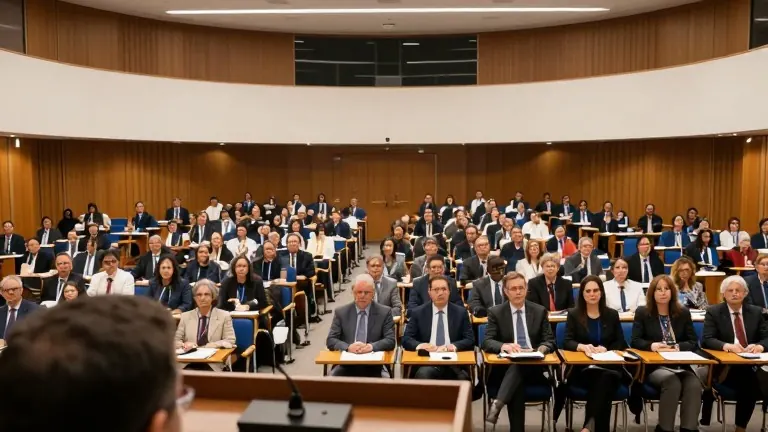
NATO Secretary General Mark Rutte voiced opposition to the idea of a single European army, warning that a new joint force could slow decision-making during a Russian attack. He made the comments at the 72nd annual session of the NATO Parliamentary Assembly in Berlin on Sunday.
Rutte said that maintaining national militaries alongside a new EU force would create duplicated responsibilities and inefficiencies. He argued that for a unified European military to work, existing national armies within EU member states would need to be abolished.
To illustrate the administrative burden, Rutte compared the proposal to the United States, where one integrated military serves the entire country rather than separate forces for states like New York or California. "My point has always been that if you have a European military, you cannot also have national militaries," he said. "The United States has one military. There is not a specific army or navy for the state of New York or for the state of California. It is one integrated United States military. If Europe is able to pull that off, fine."
The NATO chief outlined a hypothetical scenario in which NATO forces, national militaries, and a new EU armed force must operate together against a Russian offensive. He estimated that reaching a consensus on strategy among these multiple entities could take two or three weeks. "What I would counsel against is having all the nations with their own militaries working together in NATO and then on top of that having a big European structure, because then if Putin attacks, we will first need two or three weeks to agree who will do what, and then he will probably end up in Rotterdam before we have decided," he said.
Rutte expressed doubt that such consolidation would occur in the near future, noting that the current coordination between NATO and the European Union is functioning well. He described the division of responsibilities between the two bodies as being in very great shape. This debate follows a statement in March by Andrius Kubilius, the European Commissioner for Defence and Space, who argued that the EU requires a joint army due to the reduction of the US military presence on the continent.
Recent reports indicate that 71% of Europeans support the idea of the EU having its own army. This sentiment reflects growing concerns regarding the long-term reliability of the United States as a security guarantor and the deep divisions within Europe over how to handle Russia's war in Ukraine.