
Ukraine defends strike on Russian corvette in Libya as legitimate act of self-defense
The Ukrainian foreign ministry stated that the sinking of the Russian corvette Merkury in Benghazi was a valid military action under international law, while emphasizing respect for Libyan sovereignty.
By Emmanuel Faure ·
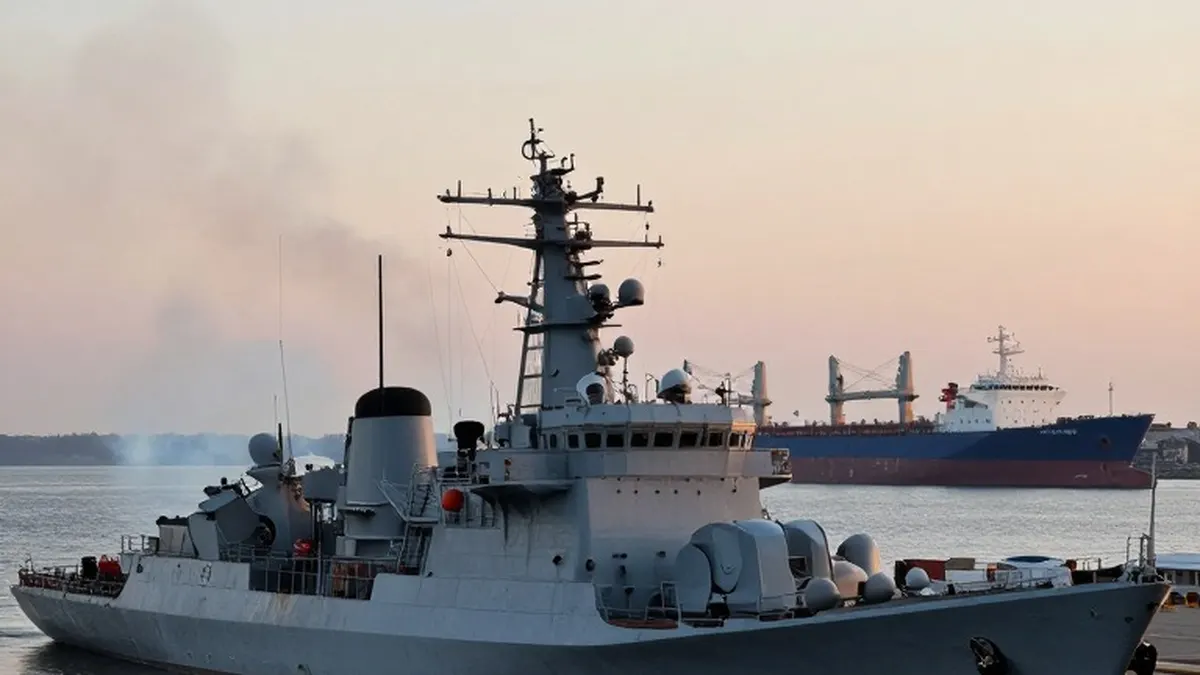
Ukraine’s Ministry of Foreign Affairs has declared that the Russian corvette Merkury, which was destroyed by drones in the Libyan port of Benghazi, was a legitimate military target. In a statement released on November 24, the ministry asserted that Kyiv exercised its inherent right to self-defense against Russian armed aggression while simultaneously expressing respect for Libya’s sovereignty and an interest in deepening bilateral cooperation.
Heorhii Tykhyi, the spokesperson for the Ukrainian Foreign Ministry, addressed journalists to clarify the legal basis for the strike. He noted that Ukraine is acting in accordance with Article 51 of the UN Charter, which grants states the right to self-defense. Tykhyi explained that this right extends to striking legitimate military targets of the aggressor, including warships, cargo vessels carrying military resources, and tankers within the Russian shadow fleet.
The spokesperson addressed concerns that Ukraine might be exporting the war or dragging other nations into the conflict. Tykhyi stated that Ukrainian actions are directed solely at the aggressor and are not aimed at any third party. He emphasized that under international law, the right to self-defense is not restricted by the location of the response, whether it occurs on the territory of the state under attack, on the aggressor’s territory, or in international waters.
Tykhyi suggested that Libya should direct its questions regarding the incident to Russia. He argued that Moscow uses the civilian infrastructure of third countries for military purposes, thereby placing those nations in danger. He highlighted that Russian warships and arms carriers regularly arrive in the region, posing a threat to Libya through Russia’s systematic use of military presence and logistical infrastructure outside its own borders, particularly in Africa.
The minister stressed that Ukraine’s actions are intended to counter Russian armed aggression and are not designed to cause harm to Libya or its people. The statement reaffirmed Ukraine’s respect for Libya’s sovereignty and territorial integrity, positioning the strike as a necessary measure to sustain Ukraine’s defense efforts.
The diplomatic comments follow confirmation by President Volodymyr Zelenskyy on November 23 that Ukrainian naval drones had sunk the Russian corvette Merkury. The vessel had a Ka-27 helicopter on board at the time of the attack. Zelenskyy also confirmed that the drones struck the dry cargo ship MV Angara, which Russia was utilizing to transport weapons, in the vicinity of the Benghazi port.
Prior to the official confirmation by Kyiv, two Libyan officials had informed the Associated Press that the Merkury suffered serious damage during a strike on a naval base in Benghazi. A fire broke out at the facility, and an initial investigation suggested the ship may have been hit by Ukrainian naval drones.
The incident has sparked reactions from Libyan leadership. Musa Al-Koni, a member of Libya’s Presidential Council, condemned the attack on the port of Benghazi. He described the strike as tantamount to a declaration of war against Libya, highlighting the tension between the parties following the engagement.
Ukrainian officials maintain that their strategy focuses on degrading the Russian war machine. By targeting assets in international waters and foreign ports, Kyiv aims to disrupt the logistical support systems that sustain the ongoing conflict, while seeking to minimize the impact on neutral parties such as Libya.