Historic Correction at Arlington as Jewish Soldiers Receive Proper Headstones
A century-old clerical error was rectified this week when three World War I veterans were re-marked with Stars of David, removing the Latin crosses that had incorrectly identified their faith.
By Madison Darwish ·
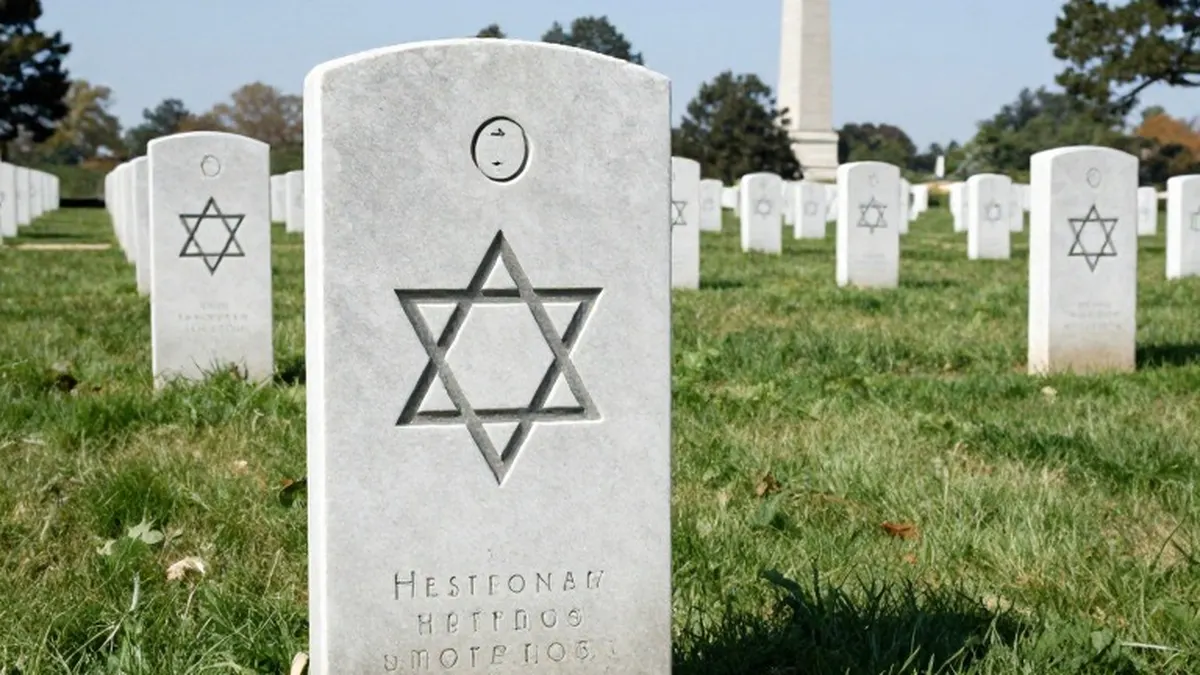
A significant historical correction took place at Arlington National Cemetery this week, addressing an administrative mistake made more than a century ago. The headstones of three Jewish American soldiers who died in World War I were replaced on November 17. The new markers feature the Star of David, replacing the Latin crosses that had long stood over their graves. This ceremony marked a poignant moment for the families and the broader Jewish community, acknowledging the true faith of the fallen.
The soldiers honored in the ceremony were U.S. Army Private David Latken, Corporal Jacob Leifer, and Private First Class Benjamin P. Yarish. All three died while serving in France during the First World War. Their remains were eventually repatriated to the United States for burial at Arlington. The error in their religious identification was uncovered by Operation Benjamin, a nonprofit group dedicated to finding Jewish American servicemen whose military graves incorrectly list their religion.
According to research conducted by the organization, each soldier met a distinct end during the conflict. Latken succumbed to wounds sustained during the Meuse-Argonne offensive in 1918. Leifer died after being severely injured by poison gas during the same campaign. Yarish was killed while fighting alongside the famous Lost Battalion, a unit that was surrounded by German forces in the Argonne Forest for five days.
Shalom Lamm, co-founder and chief historian of Operation Benjamin, explained to CNN that such errors were common due to the administrative challenges of the era. In an age before computers, identifying and reburial processes were complex. Lamm noted that clerical mistakes often occurred because soldiers were initially buried in shallow graves by their comrades on the battlefield. The remains were then moved multiple times to collection points, regional cemeteries, and finally to permanent military cemeteries. A single soldier might have been reburied four or five times before reaching their final resting place, increasing the likelihood of errors.
The research has also helped reconnect families with relatives they did not know existed. William Taubman, the 85-year-old great-nephew of Jacob Leifer, stated that he was unaware of his great-uncle until recently. Taubman expressed that it is wonderful to have Leifer’s service and sacrifice remembered. Lamm added that the organization often introduces loved ones to families who had lost touch with their history.
Operation Benjamin has now corrected more than 70 grave markers for Jewish American soldiers from World War I and World War II. The nonprofit is named after Private Benjamin Garadetsky, a Jewish soldier whose grave at the Normandy American Cemetery was marked with a Latin cross until 2018. The group’s efforts led to the replacement of his marker with a Star of David.
In other recent efforts, the organization helped identify the remains of Lieutenant Nathan Baskind in 2024. Baskind, a Jewish American soldier killed shortly after D-Day, had spent 80 years in a German mass grave. DNA testing allowed for his identification, and he was reburied at the Normandy American Cemetery under a Star of David.
The Arlington ceremony also honored a fourth serviceman, Private First Class Johann "Hans" Kasten. Although Kasten was not Jewish, his story is closely linked to the group’s mission. Captured during the Battle of the Bulge in World War II, Kasten became the elected leader of American prisoners of war at Stalag IX-B in Germany. When German commanders ordered Jewish American POWs to identify themselves for transfer to a labor camp associated with the Buchenwald system, Kasten refused to provide their names.
While being tortured, Kasten told his captors that the U.S. Army did not distinguish soldiers by religion. He instructed other POW leaders that no prisoner should admit to being Jewish. During the ceremony, Kasten’s grandsons placed memorial stones on his grave, honoring the soldier who risked his life to protect his Jewish comrades.