Crows Outpace Primates in Neural Decision Speed
New research reveals that avian brains solve complex visual tasks with the same logic as humans but at double the processing rate.
By Emmanuel Faure ·
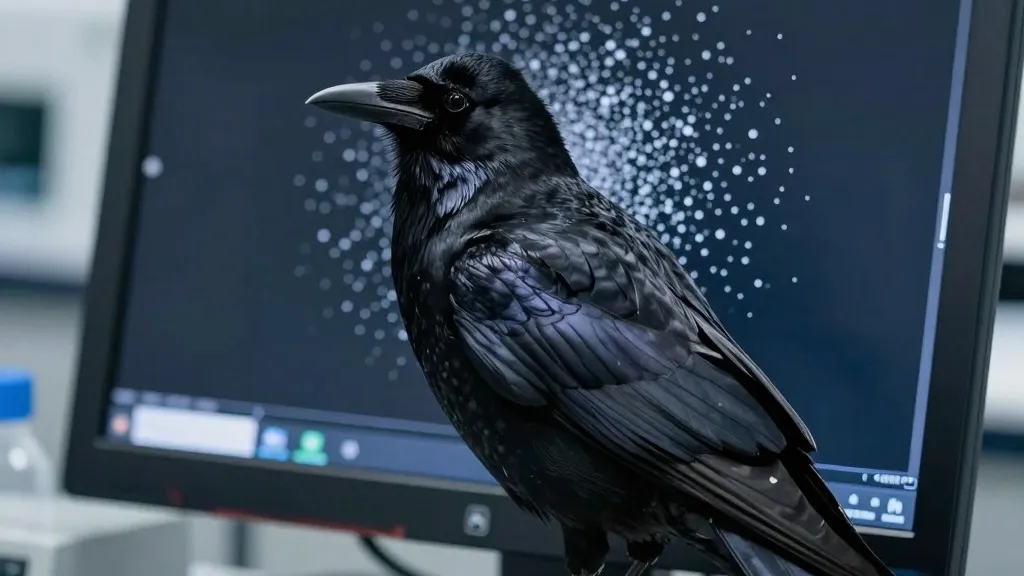
A significant efficiency gap has emerged in the study of cognitive processing, as scientists confirmed that crows execute complex decision-making protocols with the same mathematical precision as primates but at twice the speed. This discovery challenges long-held assumptions about the trade-offs between brain structure and computational performance, suggesting that alternative neural architectures can achieve superior throughput without the specific cortical layers found in mammals.
The core of this finding rests on the random-dot-motion task, a standard benchmark in neuroscience. In this test, subjects observe a cloud of flickering specks that drift weakly in a particular direction. They must determine both the presence and orientation of this movement. In primate studies, the task has demonstrated that neurons in the neocortex accumulate visual evidence over time. Their firing rates gradually increase until they cross a specific threshold, prompting the animal to commit to a choice. This accumulation model is widely regarded as the standard for how brains handle ambiguous information.
However, birds lack a neocortex entirely, leaving a theoretical void regarding how their differently organized brains manage similar cognitive loads. Andreas Nieder, a neurobiologist at the University of Tübingen, described this as the central mystery of the investigation. He noted that the primary question was how an avian brain, with its distinct anatomical layout, would encode the same kind of decision-making process. This structural difference meant that researchers could not simply apply primate models to bird behavior without empirical verification.
To bridge this gap, Nieder and colleague Philipp Schmidbauer administered the same task to two hand-raised carrion crows. The researchers recorded the birds' brain activity while they performed the task. The experimental setup involved a touch-sensitive monitor displaying white dots against a black background. A specific fraction of these dots drifted together in one of four directions: left, right, up, or down. The crows reported their chosen direction by pecking at one of the targets flanking the display. A correct identification was rewarded with a mealworm, providing a clear economic incentive for the subjects.
The research team was meticulous in ensuring the experimental conditions mirrored those used in previous primate trials. Nieder emphasized that the goal was to keep the setup identical to the monkey version to isolate the biological variables. The only procedural difference was the method of response. While monkeys indicated their decision through eye movements, the crows had to use physical pecking to signal their choice. This adjustment ensured that the cognitive load remained comparable across species.
The difficulty of the task was modulated by altering the coherence of the dot motion. At the easiest level, 81 percent of the dots moved together, making the direction trivially obvious. At the most challenging level, only 3 percent of the dots moved in unison, a signal that was barely distinguishable from random noise. The team also included a zero percent condition, where no coherent movement existed, meaning there was no correct answer. This range of difficulty allowed the researchers to map the relationship between evidence accumulation and decision time.
The results showed that the crows solved the task using the same mathematical logic as primates, despite their fundamentally different brain organization. More strikingly, they completed the decision process twice as fast as the monkeys. This finding suggests that a brain without a neocortex can arrive at robust decisions through a comparable process. For investors and analysts watching the intersection of biology and technology, this implies that efficiency in decision-making is not strictly bound to the size or complexity of the neocortex, offering a new benchmark for understanding cognitive hardware.
Source: Ars Technica
More Business · Tech news · Watch Your Wallet · Report a business