For the First Time in 23 Years, Philip Slein Gallery Fills Every Room
Philip Slein Gallery devotes its entire space to the career of St. Louis artist Edward E. Boccia, opening with a reception on Thursday.
By Emmanuel Faure ·
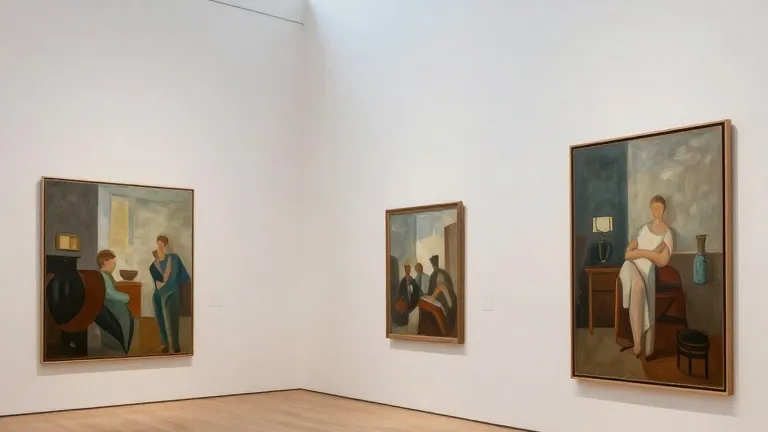
In its 23 years of operation, Philip Slein Gallery has rarely expanded beyond its front room for a single artist. That practice ends Thursday with the opening of Edward E. Boccia: An American Modernist, an exhibition that occupies every available square foot of the space at 4735 McPherson Avenue in the Central West End. The show opens with a reception from 5 to 8 p.m. on October 23 and will run through December 19.
Gallery owner Philip Slein described the scale of the installation as unusual for a private venue. "This is a very significant show," Slein said. "The only thing that could be bigger than this would be at an institution." The retrospective features more than 30 works by Boccia, who lived in St. Louis for six decades before his death in 2012.
The selection covers a wide range of subjects and formats, from small seaside scenes to monumental multi-panel pieces. The front room contains the large-scale works for which Boccia is best known, including the nine-panel autobiographical polyptych "Eugene's Journey" and the 2004 triptych "David's Death." A hallway displays mythic scenes of ocean journeys, while a salon wall in the final room traces his artistic evolution from a 1950s portrait to a painting completed in 2012.
Boccia was born in New Jersey in 1921 and served in the World War II Ghost Army. After studying at Pratt Institute, the Art Students League, and Columbia University, he joined the faculty at Washington University in St. Louis in 1951. He remained there for over 30 years, retiring in 1986 with the title of professor emeritus. Art historian Rosa Berland, who curated the show, noted that Boccia taught with rigor but encouraged students to find their own creative voice.
A companion volume titled Edward E. Boccia: Painter of Nightmares and Dreams will be published by Hirmer during the exhibition. The book, written by Berland after 14 years of research, is the first major monograph on the artist. It includes scholarly essays, historical overviews, and large fold-out plates designed to convey the physical scale of Boccia's multi-panel works. Berland identified Morton D. May as Boccia's most important patron, noting that the collector's gifts helped support the artist's career.
Berland emphasized that Boccia resisted didactic explanations of his work, preferring viewers to engage with the images directly. "Don't worry about what my art means. Just experience it," reads the exhibition pamphlet. She described the paintings as demanding a level of attention that compares to reading poetry or philosophical texts. "We don't slow down anymore," she said.
Source: St. Louis Magazine