Secretary of State Rubio Admits Economic Struggles in Post-Midterm Address
In a speech to the Federalist Society, Marco Rubio acknowledged financial hardships for Americans and criticized the use of international law to limit U.S. foreign policy.
By Emmanuel Faure ·
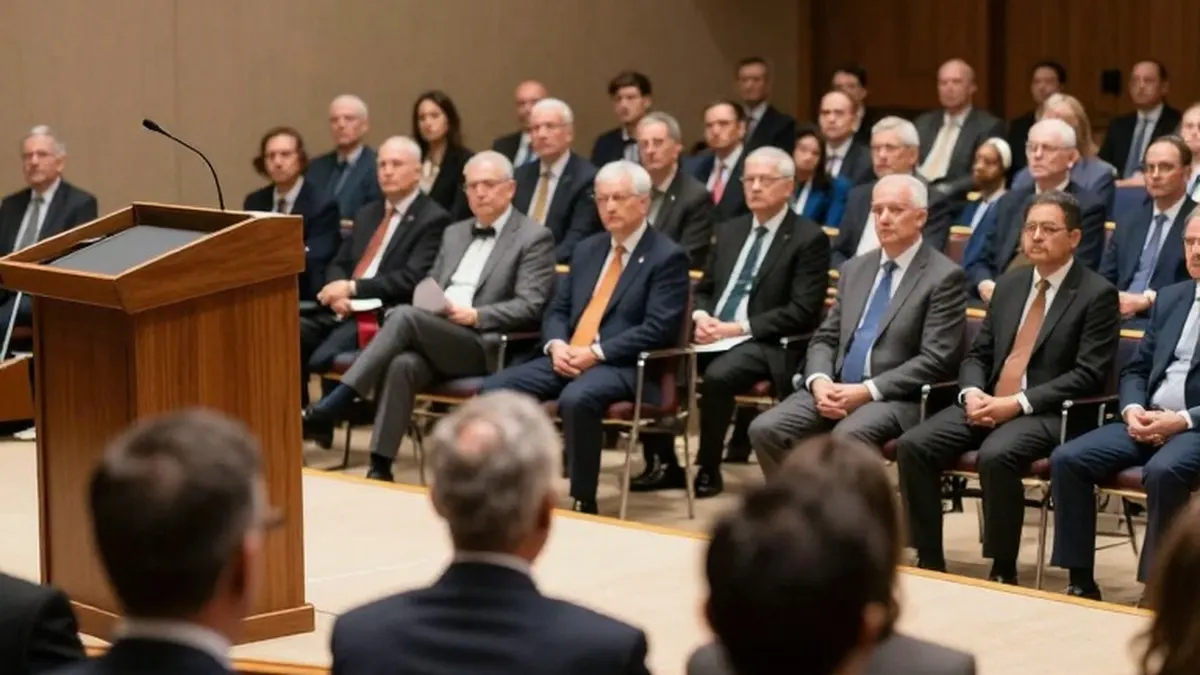
Secretary of State Marco Rubio delivered a significant address to a gathering of conservatives on Friday evening, offering candid remarks about the current state of the American economy. Speaking to members of the Federalist Society, the diplomat admitted that many citizens are facing financial difficulties, a topic that played a central role in the recent midterm elections where his Republican Party suffered substantial losses.
Rubio emphasized that economic health is defined by the ability of households to afford necessities rather than by stock market performance. He stated that there is no doubt people are struggling and that the true measure of economic well-being is whether individuals have enough money to cover their essential needs. This perspective contrasts with the frequent assertions by President Donald Trump, who often cites stock market gains as primary evidence of economic success.
The speech addressed the core grievances that drove voters to hand control of Congress to the Democrats. Many voters expressed anger over rising costs, blaming the administration for its tariff policies, the ongoing conflict with Iran, and the unfulfilled promise made two years prior to reduce prices. Despite the political context, Rubio has remained noncommittal regarding a potential presidential run in 2028, a race that could see him face Vice President JD Vance. His recent speeches, including one in Greece focusing on Western values, have suggested broader political aspirations beyond his current diplomatic role.
During the address, Rubio defended the administration's decision to engage in military action against Iran. He argued that the conflict was necessary to prevent the Islamic Republic from acquiring nuclear weapons. However, he acknowledged that the war has contributed to higher gasoline prices and other economic costs for American consumers, noting that addressing these issues is often unpopular and difficult.
Rubio also spoke about the long-term goal of ensuring that each generation is better off than the last. He described economic prosperity as a major undertaking that requires sustained effort over decades rather than being achieved within single election cycles. He expressed a legitimate fear that the current generation might be the first to leave the next generation in a worse position, a scenario he described as un-American.
The secretary also addressed foreign policy criticisms, particularly regarding the Trump administration's actions in Latin America and immigration. He defended deadly strikes on alleged drug-smuggling boats and the capture of former Venezuelan President Nicolás Maduro in January. Rubio accused international organizations and other nations of using legal standards to hinder the United States from acting in its own best interests.
He specifically criticized what he called the weaponization of international law. Rubio noted that this concept has been invoked against nearly every major foreign policy decision made by the current administration. He pointed to the United Nations, the International Criminal Court, and various international organizations as entities that seek to weaken U.S. sovereignty.
In his final remarks, Rubio challenged these international bodies for lecturing nations on sovereignty while demanding they surrender control over their borders and immigration laws. He argued that while these groups claim to oppose imperialism and domination, they frequently seek to exercise authority over governments worldwide, creating a tension between stated ideals and practical demands.
More News · National news · Report a business · Got a Story?