Yemen's War Casualties: The Families Left Behind
With 16,100 Houthi operatives killed or wounded since early October, the economic strain on bereaved families in Sanaa has intensified amidst rising fuel costs.
By Madison Darwish ·
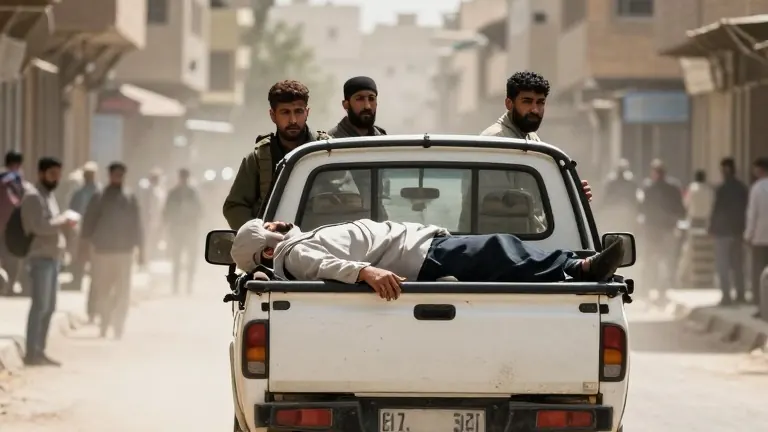
Pickup trucks rattle through the streets of Sanaa, carrying the bodies of Houthi fighters to the cemetery. Gunmen ride in the back, and loudspeakers blast a song titled “Our martyrs are our greats.” This spectacle has become a routine sight in the capital over the past few weeks as the conflict intensifies.
The Yemeni government announced last week that 16,100 Houthi operatives and commanders have been killed or wounded since October 5. In a single 24-hour period earlier this month, government forces claimed to have killed or wounded 1,540 Houthis. The fighting has also taken a toll on pro-government troops. A missile attack on a security camp in Shabwa on October 19 killed more than 70 government soldiers.
For the families of the fallen, the public tributes end at the cemetery. Akram, a 23-year-old resident of Sanaa, lost his 21-year-old brother Abdulaziz on October 10 in Dhubab, southwestern Yemen. Abdulaziz had been recruited only two months prior to his death. Before he went to the front line, the two brothers worked as daily-wage laborers in construction or agriculture. They pooled their earnings to support their six-member family, a strategy Akram described as making their financial difficulties manageable.
Without Abdulaziz, Akram struggles to cover basic expenses. He describes his brother as his pillar of strength. Their combined income used to pay for water, electricity, and food. Now, Akram feels like a bird with one wing, burdened by the responsibilities of keeping the family alive. Over the past few days, petrol and diesel prices have risen by 10 percent in Houthi-controlled northwestern Yemen, adding further pressure to households like his.
Support from Houthi authorities is irregular. Ali Yahia, a 55-year-old father of a fighter killed four years ago on the Saudi-Yemen border, receives food baskets containing flour, cooking oil, rice, and sugar. He gets these supplies two to four times a year. Yahia argues that fair compensation would be a monthly salary of at least $200, which would help cover basics. His two surviving sons, one a delivery rider and the other a restaurant worker, have improved his living conditions, but he notes that when a family depends solely on a fighter’s income, the death sparks a living and psychological ordeal for everyone.
The World Food Programme reports that 18.3 million people across Yemen face severe food insecurity, while 2.2 million children under five suffer from acute malnutrition. Matthew Hollingworth, the organization’s Assistant Executive Director for Programme Operations, stated earlier this month that the latest escalation threatens to be absolutely devastating for food security. He warned of a hunger crisis that will grow as it persists.
Ali Mohammed, a Houthi representative in Sanaa, acknowledged that the rising number of martyrs affects the level of support available. He said assistance is distributed so every family receives some, though he believes a complete Houthi victory will eventually lead to stability and better care. Adel Dashela, a researcher at the Sanaa Center for Strategic Studies, called the public celebration of fallen fighters an alien practice that normalizes violence. He noted that public displays of honor do not alleviate suffering. Instead, women and children bear the real cost of these losses, taking on the burden of supporting their families after the breadwinner is gone.
Source: Al Jazeera