215 kilowatts: Final solar arrays set to complete ISS power upgrade
Two astronauts began a six-and-a-half-hour spacewalk Thursday to install the seventh of eight new solar blankets, a task that will boost the station's output to its maximum capacity by November 5.
By Alina Marshall ·
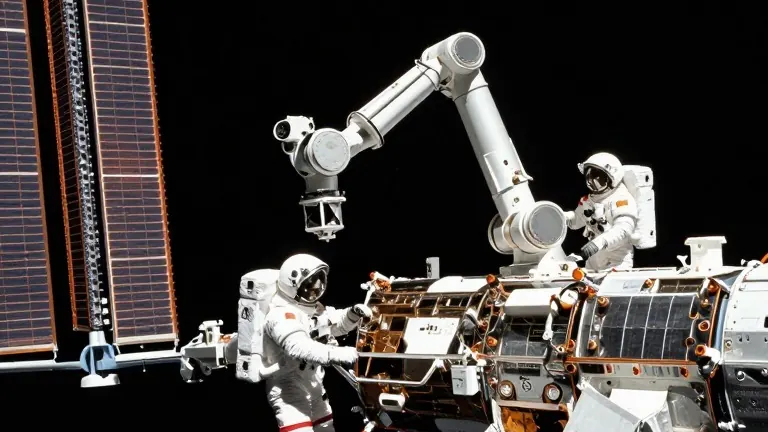
The International Space Station will generate 215 kilowatts of power once the final two sets of roll-out solar arrays are installed, a figure that exceeds the 152 kilowatts produced by the station's original aging panels.
NASA astronaut Anil Menon and Canadian Space Agency astronaut Joshua Kutryk began the first of two spacewalks Thursday at 7:57 a.m. EDT. They floated in the Quest airlock, switching their suits to battery power to start a planned six-and-a-half-hour excursion. This marks the eighth spacewalk of the year and the 285th since the station's assembly began in 1998.
The primary objective is to install the seventh International Space Station Roll-Out Solar Array, or IROSA, on a support fixture at the base of one of the station's left-side inboard solar wings. Six IROSAs are already in place, having raised the station's power output to approximately 200 kilowatts. The new arrays feature more efficient solar cells than the original panels, allowing for greater energy generation in a smaller footprint.
The hardware arrived earlier this month on a SpaceX Cargo Dragon capsule. Flight controllers at the Johnson Space Center in Houston operated the station's robot arm to remove the folded arrays from the ship's unpressurized trunk and stow them on the left side of the power truss.
Moving the equipment to its mounting point requires careful coordination. Each folded IROSA weighs about 750 pounds and measures roughly 10 feet in length. Garrett Hehn, a spacewalk flight director, described the logistics as a challenge. He noted that controllers developed specific maneuvers to rotate the array around its center of mass rather than the crew member, a technique designed to reduce fatigue for the astronaut holding the load.
Menon, who has performed three spacewalks earlier this year, will be anchored to the end of the station's 58-foot robot arm. He and Kutryk, who is performing his first extra-vehicular activity, plan to unbolt the stowed array and position it on its support frame. They will then unfold the two halves and bolt them together before making electrical connections to power channel 2A.
The arrays deploy using stored energy, a process Hehn compared to a snap bracelet. Magnets along the side allow the blankets to unroll steadily without motors, a sequence that takes about 10 minutes. The work is scheduled to be performed when the station is on Earth's night side to ensure the arrays are not generating power during installation.
A follow-up spacewalk is scheduled for Thursday, November 5, to install the final IROSA on the far right end of the power truss. The robot arm cannot reach that location, so Menon and Kutryk will hand the array to each other in a leapfrog fashion to transport it to the waiting support frame. Gaurang Patel, a senior manager in NASA's Low Earth Orbit Program, stated that this final installation will complete the power augmentation upgrades for the station's operation through its planned de-orbiting in 2030.
Source: KCNC-TV