223,000 ethnic Germans in Kazakhstan keep Soviet camp history alive
Young activists and academics are documenting the legacy of deportations and forced labor sites, despite limited local interest in the country's brutal past.
By Alina Marshall ·
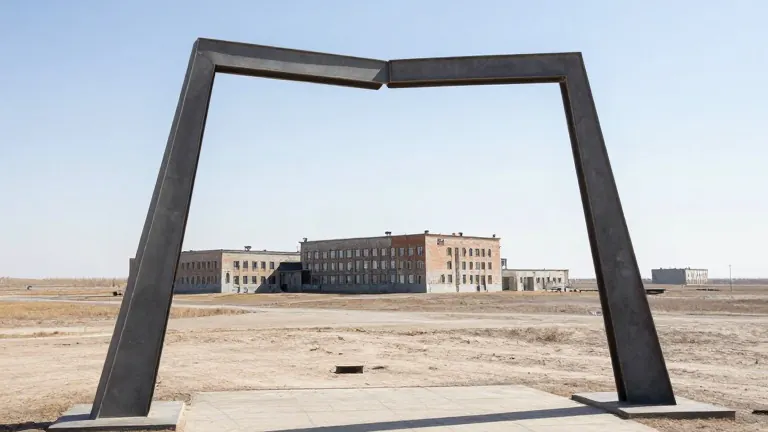
The daily reality for roughly 223,000 ethnic Germans in Kazakhstan involves a complex identity that blends German heritage with local Kazakh traditions. For many in this community, the present is shaped by the specific history of their ancestors' survival under Soviet rule. In Astana, the modern capital of the Central Asian republic, a group of young people is working to preserve these stories through theater, film, and research.
Yunna Kinereish, 22, is a student of public relations in Astana who identifies as both Kazakh and German. She is a member of the Wiedergeburt Association of Germans in Kazakhstan. Kinereish recently performed in a youth theater production at the association's office, a venue known as the House of Friendship. The play depicted the fate of German forebears who were deported from Ukraine and Russia during World War II. She notes that the performance required her to remain strong on stage while personally feeling deeply moved by the narratives.
The deportation began after Nazi Germany invaded the Soviet Union in 1941. Joseph Stalin ordered the relocation of hundreds of thousands of ethnic Germans to Siberia and Kazakhstan. Soviet authorities treated these individuals as collective punishments for the war, labeling them spies and collaborators. More than one million people were deported, and at least 200,000 died from expulsion, hunger, and forced labor. Kinereish's own family was driven out of the Ukrainian village of Kleinwärter, a settlement established by ethnic Germans in the 18th century.
Beyond theater, Kinereish documents history through film. In 2025, she produced a movie focusing on German women held in ALZhIR, a camp for wives of political prisoners. The ALZhIR facility was part of the Soviet Gulag system in Kazakhstan. Approximately 18,000 women passed through this specific camp, including 167 ethnic German women. These women were imprisoned solely because their husbands were convicted as traitors or enemies of the state. The memorial for this camp sits just outside Astana, a city that became the capital only in 1997.
The ALZhIR museum contains personal items, models of quarters, and original documents from the female prisoners. One featured figure is Gertrud Platais, a print worker from Lower Silesia who was arrested in 1938. She was forced to work as an embroiderer in ALZhIR until 1946, enduring summer temperatures of 40 degrees Celsius and winter lows of minus 40 degrees. Afterward, she was sent to the Karaganda Corrective Labor Camp, known as Karlag, where she remained until her rehabilitation in 1956.
Karlag was the largest camp system in the region, covering an area roughly 22 times the size of New York City. It operated as an economic and agricultural complex from 1931 to 1959. Nearly one million people passed through it, and about 10,000 died between 1940 and 1950 from starvation, cold, and labor. The museum for this site is located in Karaganda, 250 kilometers south of Astana, in the building that once housed the camp administration. German historians note that the current exhibition feels staged, with reconstructed torture cells and melodramatic music, and that the site sees few visitors.
Katherine M. Erdman, an American anthropologist at Nazarbayev University in Astana, has studied the Gulag system for a decade. Her research uses drone flights to locate camp sites and interviews locals to understand how forced labor shaped the landscape. She notes that factories and houses in many regions were built by forced laborers. Despite this, she reports that local responses to her findings often range from apathy to rejection. Many residents prefer to focus on the country's current economic advancement rather than its darker historical chapters. Kinereish and other young activists continue their work to ensure these specific histories are not lost.
Source: Deutsche Welle