Lunar Water Study: Musk and Bezos City Plans Outrun Supply
A Harvard-led analysis finds that power is manageable for a million residents but water recycling at the moon would fall far short.
By Alina Marshall ·
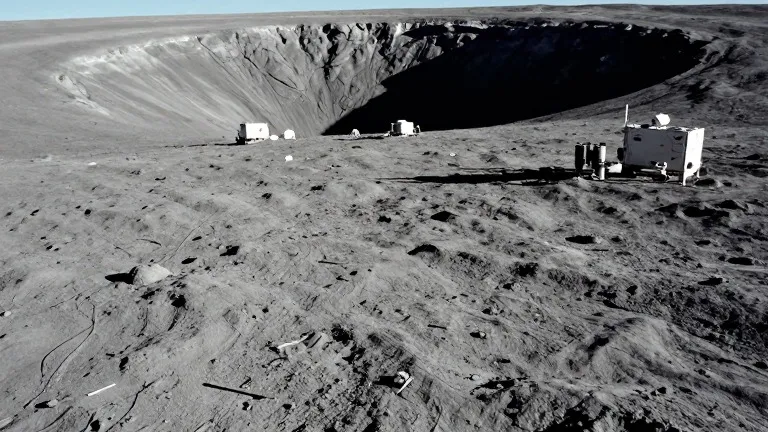
A million-person lunar city would exhaust the moon's water in about 100 years, according to an analysis published in Frontiers in Space Technologies by Martin Elvis of the Smithsonian Astrophysical Observatory and Jonathan McDowell of Durham University. The same calculations show solar and nuclear power could support that population; water cannot.
The work began in response to public claims about lunar scale. Elon Musk wrote in February that SpaceX had shifted from Mars to building a "self-growing city on the moon" in under 10 years. Jeff Bezos has said "millions of people" will live in space by 2045.
Elvis and McDowell modeled the two inputs those plans require. They took the estimate of roughly one billion tonnes of water in permanently shadowed polar regions, then assumed 98 percent recycling, the rate the International Space Station achieves. Under that combination, a settlement of one million would last about 100 years.
Elvis called the figure modest for its size, comparing it to an aquarium the scale of Central Park filled to the Statue of Liberty's shoulders: "It's a small lake," he said, "and a small lake is not going to supply a big city for very long." A town of 10,000 would hold for centuries under the same rules. McDowell said covering the moon with cities, as science fiction imagines, requires bringing water there: "it's not there right now."
The estimate carries its own caveats. Elvis said the one-billion-tonne figure is probably "20 or 30 times too big," and that only a third to half of any water present could be recovered, leaving about one percent of the original figure; that would take the 100-year figure down to one. Gordon Osinski, who studies planetary geology at Western University, said satellite measurements carry uncertainties and that the ice could sit as sub-millimetre crystals mixed into soil, which are hard to extract.
McDowell said the numbers should not read as discouraging: "The truth is never negative," he said. "What's negative is to actually go and try and do something that isn't going to work."
Source: CBC News