Student List Moves to Negotiate Coalition After Serbian Election Sweep
The movement won 141 of 250 seats but has not named a prime minister, and Serbia must hold a presidential vote by December 27.
By Emmanuel Faure ·
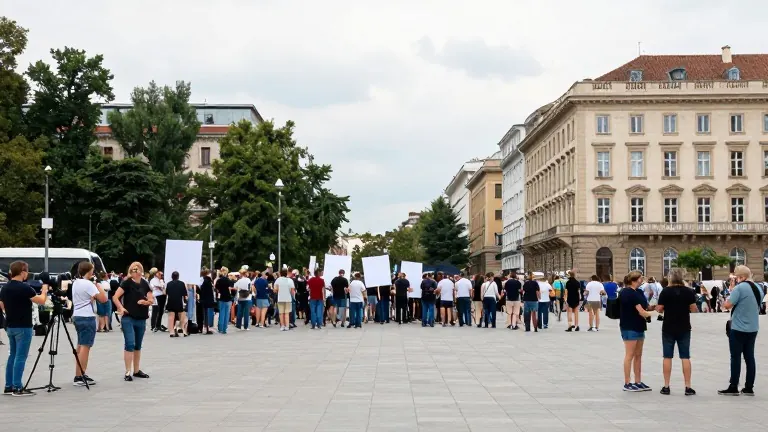
Serbia's Student List is starting talks on forming a government after its candidates captured 53% of the vote, ending Aleksandar Vučić's 14 years in power. Vučić conceded late on Sunday. His Serbian Progressive party took 39%, giving it 103 seats.
The Centre for Free Elections and Democracy in Belgrade released projections with 100% of ballot samples counted. Those figures give Student List 141 seats in the 250-seat parliament. Seats left over went to national minority party lists.
The movement has no leader and no hierarchy, so it has not named a prime minister or a cabinet. Its candidate list included academics, actors, farmers and students. Prominent figures include Ilija Srdanović, a cardiologist who headed the list; Dejan Šoškić, a former central bank governor; and Radomir Saičić, a chemistry professor at Belgrade University, who spoke for the List after the result.
Candidate Ana Mirković, a university educationist and psychologist, said the movement treats the outcome as a duty rather than a prize. "We do not see the election result as gaining power and privileges, but as taking on a historic debt to our own people and to our own children," she said. She said the first task is "the social and psychological detoxification" of the country.
The platform calls for an independent police unit that reports to prosecutors instead of the interior ministry, and for the removal of police officers linked to organised crime. It would bar appointments of party loyalists to state-owned companies. New independent bodies would review major state infrastructure contracts to check how public money is spent. Mirković said the government would open the media, end pressure on public-sector workers and stop what she called institutional violence.
State institutions are staffed with civil servants loyal to the outgoing leadership. Analyst Dušan Vučićević said the movement "insisted as much as possible that Serbia must first and foremost address domestic political issues" and that this meant "the literal dismantling of every institution, from the national to the local level". Nikola Burazer of the Centre for Contemporary Politics in Belgrade said the movement's process for choosing candidates "actually took a long time - months" and that its decision-making process needs to move faster.
The campaign stayed away from foreign policy questions, including relations with the EU and Russia. The Kremlin said on Monday it hopes the new leaders "understand that cooperation with Russia is in Serbia's interests". German chancellor Friedrich Merz said Berlin would "actively support Serbia's European path". Ukrainian president Volodymyr Zelenskyy said, "This is clearly a new chapter in the history of the country and its people."
The constitution requires the new parliament to convene within 30 days of the official result, then gives 90 days to form a government. Serbia must hold presidential elections before 27 December, because Vučić left that office to run for prime minister.
Source: The Guardian