Sun Xun's 'Magic Atlas' Blends Mixed Media to Depict a Surreal Coal Empire
The Singaporean production takes ten years to create and shifts between ink, paint, and woodcut styles to tell a fragmented story about a fascist state.
By Madison Darwish ·
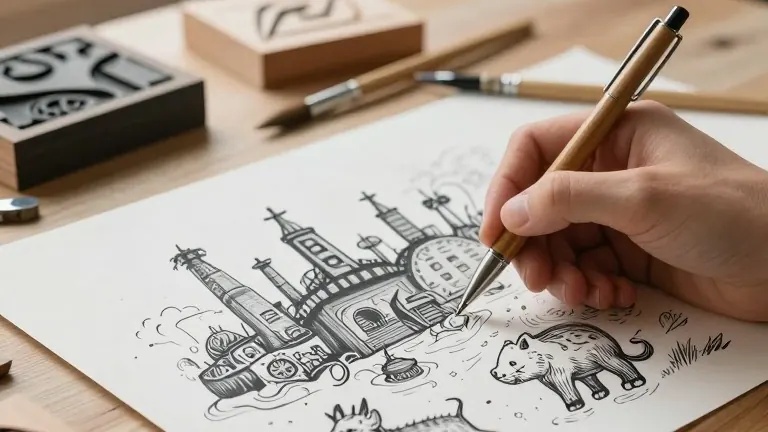
Sun Xun has finished a decade-long animation project that utilizes a wide range of physical materials to depict a surreal coal empire.
Pi Animation Studio in Singapore produced the film, which is titled 'Magic Atlas.' The work takes approximately ten years to complete. Xun employs paint, pen and ink, canvas, newspapers, and woodcut techniques throughout the picture. The director uses these tangible elements to create a dreamlike visual style that prioritizes texture over digital smoothness. This approach contrasts with the current industry focus on artificial intelligence and computer-generated imagery.
The narrative centers on a coal empire called Luocha, which is governed by fascist industrialists. An orphan named Xiao Zhi serves as the protagonist. A imprisoned magician helps Xiao Zhi access the state secrets and recover memories that the government has taken from the citizens. The film does not prioritize plot clarity. Instead, it builds its mood through fluctuating, inky illustrations. Xiao Zhi frequently disappears from the screen after he begins to question the world he has been taught to see.
The opening sequence features the Avatamsaka Sutra, a Buddhist scripture about time. The visuals then shift to painted creatures fighting in waves. A narrator, voiced by Xun, describes himself as being everywhere without a beginning or end. The art style changes to aged pages and black ink backgrounds. Surreal hybrid animals, including a horse with a camera for a head, move across the landscape drawn with white lines on black paper. The film later transitions to blue water and a black whale, followed by kaleidoscopic paintings that reference the work of Pieter Bruegel.
The film's aesthetic is defined by a monochrome palette of heavy black shading and white outlines. Xun mixes cartoonish expression with intense painting detail. The style constantly shifts to avoid a single look. Scenes move from backroom political scheming and factory lines to natural landscapes. A mass surveillance system made of giant mosquitoes appears in the film. The generals accuse a child of having false memories, a charge that highlights the regime's control over truth. One sequence, created during the isolation of the Covid-19 pandemic, was a collaboration with international artists.
Xun has stated that he is not concerned if every viewer understands the film's symbols. The production combines folkloric imagery with science fiction elements. A man in a mouse costume appears during a festival scene, a detail that may reflect the co-option of art by the state. The film's fragmented nature makes it difficult to connect with emotionally for some viewers. The technical variety prevents the work from feeling entirely alienating.
Source: Variety