House Map: 435 Seats, 46 Battlegrounds, and the Three-Seat Margin
With polls open, the House race hinges on a razor-thin three-seat margin and newly drawn districts in seven states.
By Madison Darwish ·
Voters across the United States are deciding the composition of the U.S. House of Representatives on Tuesday, November 3, 2026. All 435 seats are up for election in this midterm contest, which occurs halfway through President Donald Trump's second term. The outcome will determine which party controls the chamber for the president's final two years in office. According to Ballotpedia and USA.gov, the current balance of power is extremely tight, with Republicans holding 218 seats and Democrats holding 214. One independent seat is currently held by a non-affiliated member. There are also vacancies in the chamber.
The arithmetic of this election is defined by a narrow margin. Democrats need a net gain of three districts to secure a majority in the House. Conversely, Republicans can afford to lose no more than two seats to retain control. This three-seat difference makes every vote in competitive districts critical. The Associated Press notes that the race is effectively a referendum on the president's performance, with many voters expressing frustration over high prices and an unpopular war with Iran. Polls remain open, and no results have been announced yet.
The geographic landscape of the House race has shifted significantly due to mid-decade redistricting. Ballotpedia identifies 46 battleground districts where the outcome is in play. Of these, 25 are currently held by Democrats and 21 by Republicans. The new maps have altered the competitive nature of districts in seven states: California, Florida, Missouri, North Carolina, Tennessee, Texas, and Ohio. These states are now using different congressional boundaries than they did in the 2024 presidential election.
The new maps have created a complex set of challenges for both parties. Twenty-one districts currently held by Democrats voted for Donald Trump in 2024, suggesting these seats may be more competitive for Republicans. In contrast, nine districts held by Republicans voted for Kamala Harris in 2024, indicating they may be vulnerable to Democratic challenges. The Associated Press reports that Republicans are bracing for potential losses in the House, while Democrats are cautiously optimistic about their chances. Both parties acknowledge that the margin for error is extremely small.
Incumbency plays a significant role in this cycle. Ballotpedia reports that 60 House incumbents are not running for re-election. This group includes 23 Democrats and 37 Republicans. The absence of these established figures has opened the door for challengers in a larger number of districts. The Associated Press highlights that the election is likely to be the most expensive in history, with Republican committees outraising and outspending their Democratic counterparts at the national level. However, at the individual candidate level, Democrats have managed to outraise their opponents.
Voter sentiment is a key factor in the House race. An AP-NORC poll indicates that 35% of U.S. adults approve of President Trump's job performance, while 25% approve of his handling of the economy. About seven in 10 Americans say the country is heading in the wrong direction. Many voters blame the president for high prices. Mark Barker, a voter in Palm Beach Gardens, Florida, told the Associated Press that he has been following Trump and thinks he is doing an awesome job. James Moore, a librarian in Raleigh, North Carolina, stated that he is paying more for taxes, healthcare, and everything else.
The party leaders are focused on turnout and messaging. Joe Gruters, the Chairman of the Republican National Committee, stated that everything depends on turnout and that they will win if they turn out their voters. Suzan DelBene, the Chair of the Democratic Congressional Campaign Committee, said that the American people are angry and want change. These statements reflect the strategic priorities of each party as they mobilize their bases. The Associated Press notes that one or two seats could tip the balance of power in either chamber.
The new maps in states like Florida and Texas may not vote as originally drawn. Republicans attempted to beat the historical midterm pattern of the president's party losing seats by using redistricting. However, the Associated Press notes that the new districts may still be competitive. The focus is now on the 46 battleground districts where the outcome is uncertain. Voters are casting their ballots in these districts to determine whether the House majority shifts or remains with the Republicans. The three-seat margin is the central metric for this election.
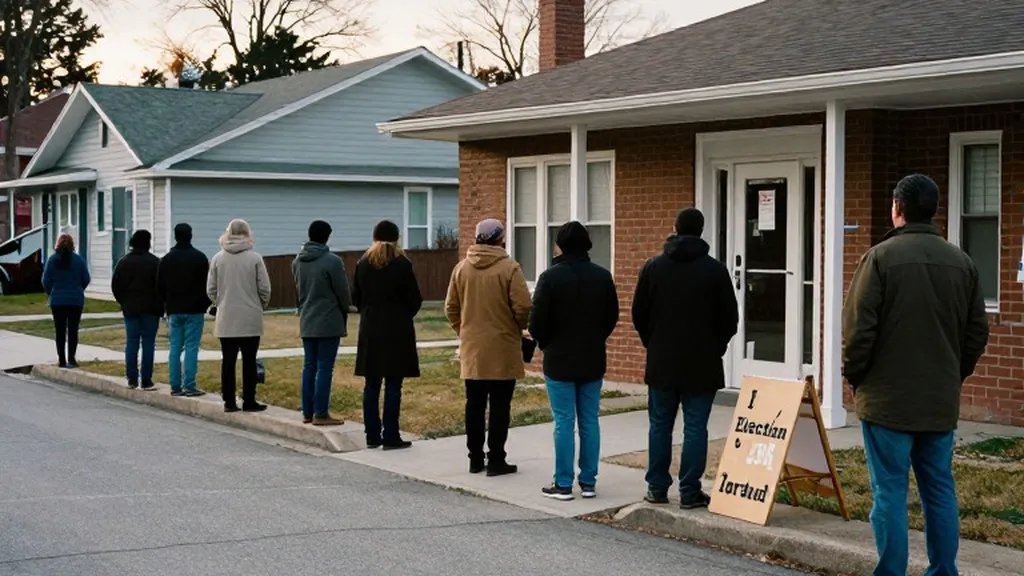
As polls open, voters are lining up to cast their ballots in these critical districts. The Associated Press reports that more than 57 million people had already voted as of Monday, surpassing early vote totals from four years ago in many states. The U.S. Postal Service has added hours and staff to ensure mail ballots are counted on time. The race is not just about the president's popularity but also about the local issues facing voters in these 46 districts. The final tally will depend on how voters in these specific areas decide to vote on Election Day.