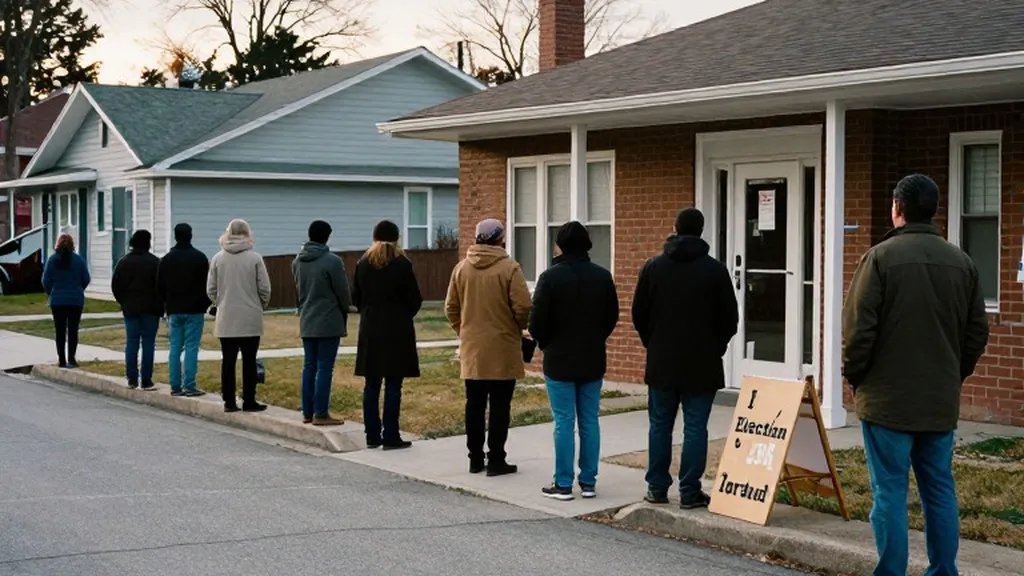
Voters Decide Senate And Governor Control In Key Midterm Races
With polls open across the country, the outcome of 35 Senate seats and 36 governorships will determine the balance of power in Congress for the final two years of President Trump's second term.
By Alina Marshall ·
Voters across the United States are heading to the polls on Tuesday, November 3, 2026, to decide the control of Congress for the final two years of President Donald Trump's second term. This midterm election is shaping up as a critical referendum on the administration's performance, with all 435 House seats and 35 Senate seats up for grabs. The Associated Press describes the mood as one where many Americans are struggling with high prices and are angry over an unpopular war with Iran. More than 57 million people had already cast their ballots as of Monday, surpassing early voting totals from four years ago in many closely watched states.
The Senate race is particularly contentious, with Democrats needing a net gain of four seats to achieve a majority. Republicans currently hold 53 seats, while Democrats hold 45, plus two independents who caucus with Democrats. According to Ballotpedia, 13 Senate races are considered battlegrounds, including contests in Alaska, Florida, Georgia, Iowa, Kansas, Maine, Michigan, Montana, Nebraska, New Hampshire, North Carolina, Ohio, and Texas. In Maine, Senator Susan Collins faces a tough challenge from Democratic former state Senate President Troy Jackson, with the race rated a toss-up by major political analysts. The Associated Press notes that economic strain and tariffs have made the state competitive for Democrats.
Key matchups in the Senate include former Governor Roy Cooper of North Carolina running against former Republican National Committee chair Michael Whatley in a state where Trump won by a narrow margin. In Georgia, incumbent Senator Jon Ossoff is seeking reelection against Republican Representative Mike Collins. The race in Ohio features former Senator Sherrod Brown challenging incumbent Senator Jon Husted, while in Michigan, Republican former Representative Mike Rogers is competing against Democrat Abdul El-Sayed. In Texas, Republican Attorney General Ken Paxton, who was backed by President Trump in the primary over Senator John Cornyn, is running against Democrat James Talarico. These races are pivotal because a net gain of four seats by Democrats would shift control of the chamber.
Governor races are equally critical, with 36 governorships on the ballot. Republicans hold 26 governor's offices and Democrats 24, with each party holding 18 of the 36 offices currently up for election. Nineteen of these races have no incumbent on the ballot, including in states like Iowa, Minnesota, and Wisconsin where the sitting governors chose not to run or were term-limited. Democrats would need a net gain of two governorships to achieve a nationwide majority, a feat they have not accomplished since 2010. Notable governor races include Georgia, where Republican health care executive Rick Jackson is running against former Atlanta Mayor Keisha Lance Bottoms, and Nevada, where Republican Governor Joe Lombardo faces Democratic Attorney General Aaron Ford.
In Ohio, Republican Vivek Ramaswamy is competing against Democrat Amy Acton for the governorship. Ramaswamy's campaign has faced some backlash over an advertisement featuring Acton's estranged mother, but the race remains competitive. The Associated Press also identifies Texas, Florida, and Iowa as competitive governor races. Democrats are hoping to hold a majority of governorships for the first time in two decades, which would provide a significant legislative advantage in states where they currently have a presence. The outcome of these races will influence the ability of each party to push through state-level legislation and appointments.
Polling data from the AP-NORC survey indicates that 35% of U.S. adults approve of President Trump's job performance, while 25% approve of his handling of the economy. Approximately seven in ten Americans say the country is heading in the wrong direction, with most blaming the president for high prices. This sentiment is driving voter turnout in both parties. Republican National Committee Chairman Joe Gruters stated that everything depends on turnout, asserting that if they turn out their voters, they will win. Conversely, Democratic Congressional Campaign Committee Chair Representative Suzan DelBene said the American people are angry and want change, highlighting the high stakes for both parties.
The election is also marked by significant financial spending, with the 2026 elections likely to be the most expensive in history. Republican committees have outraised and outspent Democratic committees, aided by Trump-affiliated groups and Elon Musk. However, at the candidate level, Democrats have outraised their opponents. Analysis of AdImpact data by the AP shows that 88.1% of Republican general election TV ad spending went to states and districts Trump won in 2024, including more than $850 million in areas where he won by 10 points or more. This spending strategy reflects the focus on holding onto key districts and seats in the House and Senate.
Election administration has been a point of contention, with a federal judge temporarily barring the Trump administration from carrying out a plan to prevent noncitizen voting. Critics argue this plan risks disenfranchising eligible voters and infringes on states' authority over elections. Additionally, a judge ordered the administration to stop demanding that California election officials segregate ballots cast by people on lists of suspected noncitizens. The U.S. Postal Service has added hours, staff, and special lines to ensure mail ballots are counted on time, addressing concerns about potential delays in mail-in voting processes.
Voters in various states are facing different poll hours and procedures. For instance, in Florida, polls are open from 7 a.m. to 7 p.m., while in California, voting is largely by mail, with polls open from 7 a.m. to 8 p.m. In New York, polls are open from 6 a.m. to 9 p.m., and in Texas, from 7 a.m. to 7 p.m. ID rules vary by state, and voters are advised to check their local requirements before heading to the polls. Anyone in line when polls close is entitled to vote, ensuring that late arrivals can still participate in the election.