Students Excavate Historic New Mexico Shrine
A collaborative summer course combined archaeology and oral history in the Embudo Valley.
By Emmanuel Faure ·
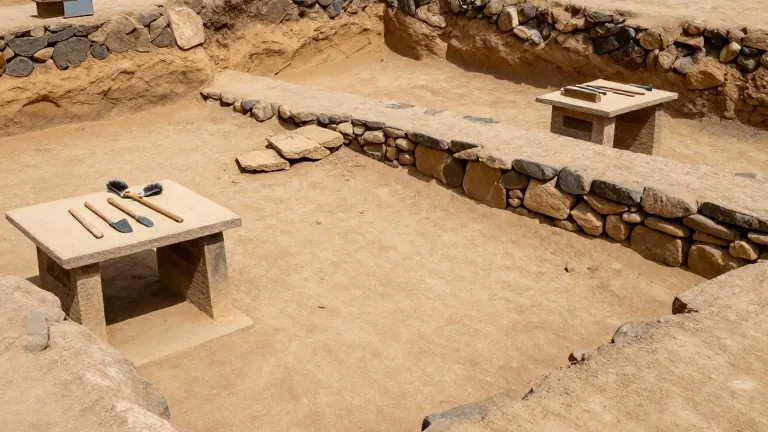
Students from three universities spent the summer digging in the New Mexico desert.
The team focused on an abandoned Penitente morada in Dixon. This site served as a religious gathering place for local communities. The project combined physical excavation with interviews of community members. The goal was to document traditions that were fading from memory.
A Chicana and Chicano Studies class at the University of New Mexico led the effort. Students from Barnard College and Columbia University joined the fieldwork. The group excavated the site and recorded oral histories about morada practices in northern New Mexico and southern Colorado.
The digs revealed several structural and religious artifacts. Students uncovered portions of adobe walls and stone foundations. They also identified an altar area. A rosary was recovered from the site.
The work touched on four main themes. These included the intersection of Indigenous and Hispano cultures in the region. The team also examined archaeological and oral history methods. The course linked academic research with community activism. It relied on collaboration among the three participating institutions.
Levi Romero, an associate professor emeritus at UNM, taught the class. He worked alongside Severin Fowles, a professor at Columbia University and Barnard College. Romero said he enjoyed seeing how the field class influenced the students' academic scholarship.
The site selection followed a presentation by Romero. He discussed morada history in the Embudo Valley last December. The talk took place at the Embudo Valley Library for Dixon's 300th anniversary.
Six UNM students and 10 students from the partner colleges participated. The group also assisted with local feast day preparations. They helped Picuris Pueblo with its Dia de San Lorenzo event on August 10. They also aided parishioners at La Capilla de Nuestra Senora de Los Dolores in Pilar for its September 15 celebration.
Valerie Chavez, a doctoral student in Chicana and Chicano Studies, participated for the third time. She noted that community knowledge gave meaning to the physical work. Excavation allowed the team to document a place whose physical remains had largely disappeared.
Chavez wrote in a reflection paper that archaeology is not just about recovering objects. It can involve recovering memories and honoring traditions. The process helps communities preserve histories that might otherwise vanish.
The class ends with a community presentation of findings. Local guest speakers also share insights during the course. Some materials are now part of a permanent exhibit at the Embudo Valley Library.
Romero hopes to establish an archive center in the village. He suggested the abandoned Sala Filantropica dance hall as a potential site. This property is owned by Rio Arriba County. The group plans to continue fieldwork and oral history documentation.
Source: UNM Newsroom